
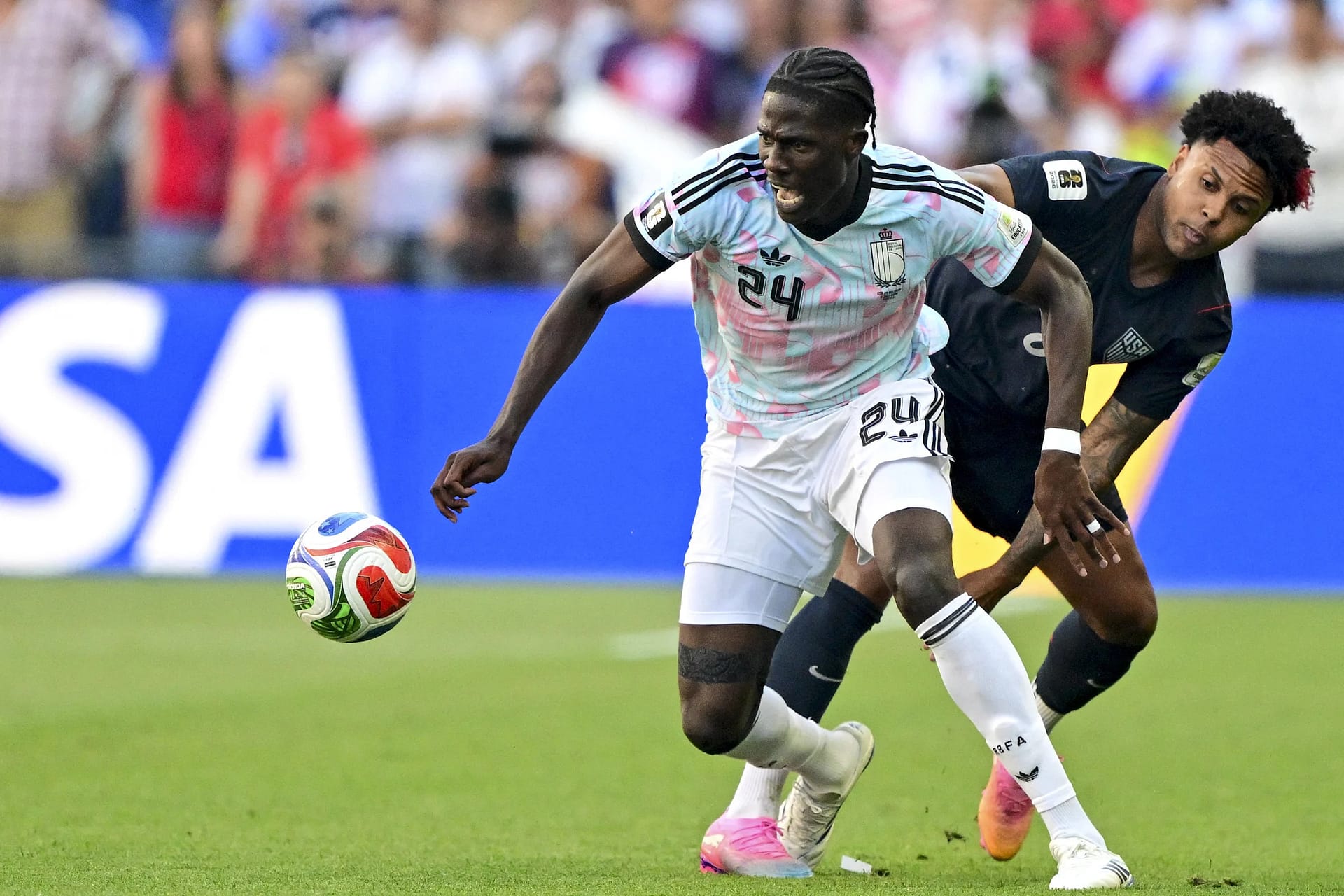
Belgium’s midfield lynchpin Amadou Onana has sustained a ruptured anterior cruciate ligament (ACL) during his team’s 4-1 World Cup Round of 16 triumph over the United States, delivering a significant setback to both the Red Devils and his club side, Aston Villa. The 24-year-old Belgian midfielder was compelled to leave the field in the opening half after a knee injury suffered in a collision with U.S. defender Antonee Robinson. Belgium coach Rudi Garcia confirmed after the match that Onana’s injury is likely to rule him out of the remainder of the tournament, and subsequent reports have corroborated the diagnosis of an ACL rupture. This grim development comes at a critical juncture for Belgium, as their squad had just overcome a stiff challenge from the United States to secure a place in the quarterfinals and set up a clash with Spain.
The injury arrived early in a game that Belgium ultimately dominated, despite the setback of going a goal behind. The Red Devils responded with clinical efficiency and tactical discipline, sealing a 4-1 victory to advance to the knockout stages with momentum and confidence. In the wake of Onana’s exit, Belgium’s midfield structure faced a disruption, but the team rallied impressively to push through to the next round. The result not only kept Belgium’s World Cup hopes alive but also signaled their potential to compete with the tournament’s strongest teams as they progress to the quarterfinals.
Onana’s diagnosis of an ACL rupture carries significant implications for both his national team and his club duties. ACL injuries typically require several months of meticulous rehabilitation, meaning Onana is likely to be sidelined for a considerable period. For Belgium, the absence of a player of Onana’s technical ability, vision, and ball progression leaves a void in the engine room that will demand tactical adjustments and collective resilience. His injury also impacts Aston Villa, where Onana has been a crucial contributor in central midfield, adding depth, ball retention, and a persistent drive to press opponents.
Despite the loss of such a key midfielder, Belgium delivered an encouraging performance against the United States. Charles De Ketelaere produced a standout display, delivering a brace that underscored Belgium’s attacking intent and capacity to convert chances clinically. Hans Vanaken added a further goal, and Romelu Lukaku contributed to the tally with a strike, rounding off a comprehensive 4-1 victory that demonstrated Belgium’s capability to adapt and overcome adversity on the world stage. The result set up a high-stakes quarterfinal clash with Spain, a matchup that promises to test Belgium’s tactical flexibility and depth as they navigate the tournament without one of their most influential players.
In the broader context of the tournament, Onana’s injury is a significant narrative as teams contend with the physical demands of extended campaigns. ACL ruptures are among the most challenging injuries for footballers, typically requiring prolonged rehabilitation, a gradual return to training, and a cautious reintroduction to competitive action. For Belgium, the immediate priority will be to maintain cohesion and balance in midfield, leveraging other creative and defensive specialists within the squad while Onana recovers. The team’s medical staff and coaching hierarchy will likely outline a structured plan to manage the midfield transition, preserve tactical integrity, and keep the remainder of the World Cup campaign on track.
As Belgium prepares for the next round, their strategic focus will center on resilience, squad depth, and the ability to contend with the loss of such a pivotal figure. The quarterfinal against Spain will be a stern test of their capacity to adapt, with the potential for young talents and veteran midfielders to step up and fill the void left by Onana. The Belgium squad’s response to this setback will be closely watched by fans and pundits alike, who will be eager to see how the team harnesses its collective strength and tactical versatility to continue competing at the highest level.
The broader impact of Onana’s injury extends beyond the immediate tournament. As Belgium, a nation with a storied footballing history, navigates the challenges of losing a key midfielder, there will be anticipation about how the squad recalibrates for future assignments. In addition to the strategic implications for the World Cup campaign, clubs and national teams alike will be paying attention to the timeline for Onana’s rehabilitation, hoping for a safe and successful return to top-level competition. The situation underscores the fragility of football careers and the importance of depth and adaptability in squad management, especially when a team is competing on multiple fronts and facing the pressures of knockout-stage football.
In summary, Amadou Onana’s ACL rupture marks a turning point for both Belgium and Aston Villa as they continue their respective seasons surrounded by uncertainty and resilience. While the Red Devils advance with determination, the loss of a midfield anchor will necessitate tactical ingenuity and collective effort to maintain momentum. The quarterfinal countdown against Spain now carries additional weight, as Belgium seeks to demonstrate that they can overcome injury setbacks and still contest the world stage with precision, intensity, and strategic depth. Fans will be watching closely to see how the squad adapts, who rises to the occasion in midfield, and how Onana’s long-term recovery unfolds as he embarks on an arduous rehabilitation journey.
Content Source: Yahoo News
Image Credit: Getty Images
All rights to the news content and images belong to their respective copyright owners.