
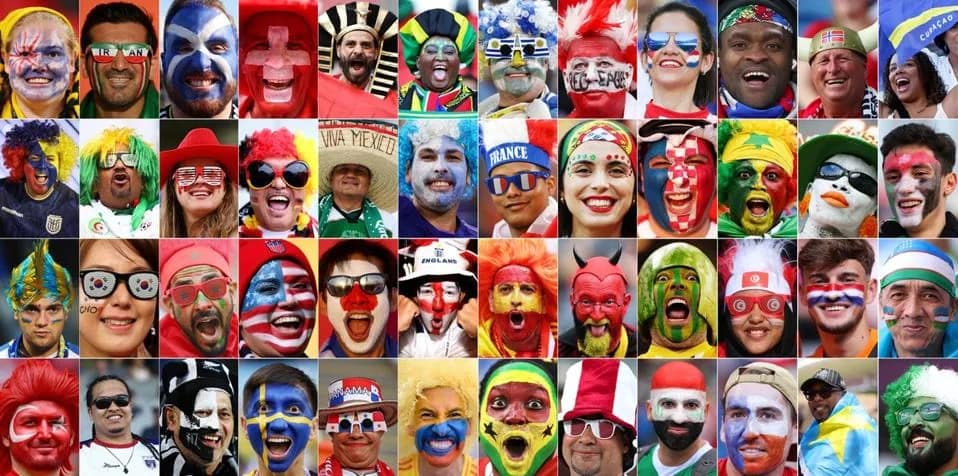
The final won’t be played until next month. The trophy still sits in a case in East Rutherford, waiting for a name. And yet something has already been decided, something the bracket can’t measure and the broadcast won’t announce.
The World Cup has already won.
I noticed it before I understood it. A man in a Lyft, a Senegalese flag knotted around his rearview mirror, arguing with his own radio about a Norwegian back line. A taqueria in a city without a team in the tournament, packed at ten in the morning, every screen tuned to the same match. Two strangers at a counter who would agree on nothing else discovering they agree, completely, that the referee was wrong. None of it was organized. None of it was for show.
This is the part of the World Cup that gets lost in the coverage of who advances. The tournament’s real output isn’t a champion. It’s the temporary collapse of the distance between people who otherwise keep their distance.
A competition is the mechanism, not the result. The result is that for a few weeks, a planet that spends most of its time sorting itself into smaller and smaller boxes agrees to watch the same thing at the same time and care about it together.
FIFA reported that roughly five billion people engaged with the last men’s World Cup, better than half the people alive. Cited that way, it sounds like a media statistic, something for a sponsorship deck. But the number isn’t the story. It’s the residue of the story. What it records is how many separate lives briefly ran on the same clock, and it only matters because of what it confirms. The appetite for shared experience didn’t die when the screens fragmented. It was waiting for something worth gathering around.
Here’s the tension. The same decade that gave us infinite personalization, your feed, your algorithm, your private channel of outrage, also produced the largest synchronized audience in history. Those two facts are supposed to contradict each other. They don’t.
Watch what people actually do during a match. They take out the same phones that isolate them the rest of the year and use them to find each other. They text a brother three time zones away the second a goal goes in. They post not to perform but to confirm that someone else saw it too. The device built to give each of us a private world gets turned, for ninety minutes, into a tool for proving we’re in the same one. People were never choosing isolation. They were choosing the only thing on offer.
The hunger for common ground was never the problem. The supply was.
And then there’s the home team. Two wins from two to open the tournament, into the knockouts with a game to spare for the first time in the program’s history, back-to-back World Cup victories for the first time since 1930. The country that has always held this sport at arm’s length is suddenly leaning in.
It would be easy to read this as a sports story. A team exceeding expectations, a coach quieting his critics. But the more interesting thing is happening off the field. A nation that spent decades treating soccer as something other people loved is discovering it can love it too, not because the team finally got good enough to deserve attention, but because winning gave people permission to admit an interest they’d been holding all along.
The evidence was there before the first whistle. My employer Gallup found that more than a quarter of American adults already counted themselves soccer fans, and that four in ten planned to watch this tournament, nearly matching the last time the country hosted, in 1994. The same poll found the sport draws far more strongly from younger Americans than older ones. Soccer is one of the few major sports more popular with the young than with the general public, which is to say the appetite isn’t arriving. It arrived years ago, in a generation that grew up with the game, and it has been waiting for the rest of the country to notice.
The crowd didn’t show up because the team won. The team winning gave a crowd that was always latent the cover to assemble.
This one was engineered for it. Forty-eight teams, three host nations, a map that runs from Mexico City to East Rutherford. The expansion was supposed to dilute the product. The worry was that adding sixteen teams would mean blowouts, the big sides swatting away the small ones. The opposite has happened often enough to retire the worry. Curaçao, a nation of roughly a hundred and fifty thousand people, became the smallest country ever to play in a World Cup, and its goalkeeper kept a far larger opponent scoreless behind fifteen saves, tying the modern record for a single match. The minnows didn’t drown. They competed, and the competing is what the cameras found.
The crowds tracked the same way. On a single day in the group stage, more than 281,000 people passed through the turnstiles across four matches, breaking a daily attendance record that had stood since June of 1994. In Mexico, the opener drew the country’s largest World Cup audience of the century, nearly three-quarters of everyone watching television tuned to a single match. In China, a country whose team didn’t qualify, the tournament reached more than 190 million viewers in its first eleven matches. They didn’t need a side to root for. They needed an occasion, and the tournament supplied one large enough to hold them.
Something unscripted has been happening away from the stadiums. The tournament brought more than a million visitors into the country, and a striking number of them have spent the trip documenting their astonishment at things Americans stopped seeing years ago. A Japanese fan held his head in his hands over the bread at a Texas chain restaurant. A Scottish supporter stood in front of a roadside mega-store and declared, sincerely, that a place like this could only exist here. Visitors wandered the aisles of ordinary supermarkets filming the sheer volume of it, treated a gas station like a landmark, learned the words to “Country Roads” in a bar full of strangers and sang every one.
A Mexican football fan wearing a traditional wrestling mask embraces a Japanese supporter during the public screening of the 2026 FIFA World Cup group stage match between Japan and the Netherlands at the FIFA Fan Festival in Mexico City’s Zocalo, Mexico, on June 14, 2026. The match ended in a draw. (Photo by Rafael Rodriguez/NurPhoto via Getty Images)NurPhoto via Getty Images
None of this was on the itinerary. It’s the oldest move in travel, the familiar going strange in a foreigner’s eyes, except this time it ran in both directions. The visitors saw a country they hadn’t expected. The country, watching the footage of its own gas stations and grocery stores treated as wonders, saw itself the way you only can through someone else’s astonishment. What makes the country special, one viewer wrote as the posts piled up, are the things its people take for granted: the scenery, the roadside attractions, and above all each other. A tournament that was supposed to be about football turned, in its margins, into a country and its guests discovering they had misjudged the distance between them.
That’s the thing the bracket can’t hold. Two teams will meet in the final. But the quieter exchange, the one happening in diners and parking lots and supermarket aisles, was never going to show up on a scoreboard.
A reasonable person could read everything above and call it sentiment. The skeptic has a strong hand, and it’s worth playing for them rather than around them.
Unity, the skeptic points out, is also marketing copy. This tournament is projected to generate close to thirteen billion dollars across its commercial cycle, the most lucrative event in the history of sport, and every governing body that stages one of these sells it as a force for bringing the world together. Scholars who study these events call the unity story a mirage, a slogan draped over an enterprise that, whatever else it is, runs on money. Push further and the communion looks thinner still. Researchers tracking how fans behave online find them clustering inside their own language and their own flag, not dissolving into one another. The same match, watched in a hundred countries, may be a hundred different matches, each narrated back to a crowd that already agreed with itself.
All of that is true. None of it touches the thing in the taqueria.
Here is the distinction the cynic misses. The apparatus is real and the feeling is real, and the feeling is not produced by the apparatus. No marketing department can manufacture the moment two strangers turn to each other after a goal, because that moment doesn’t run on the marketing. It runs on something the marketing is trying to rent. The nationalism is real too, but a man flying his country’s flag in a stranger’s city is not retreating into his nation. He’s carrying it somewhere it can be seen, which is the opposite move. The unity isn’t anyone’s to sell, and it isn’t anyone’s to fake. It’s the residue that survives the selling. That’s why it can’t be put in a deck, and why it’s worth defending from the people who’d reduce it to one.
The trophy will be lifted. One squad will be remembered and the rest will go home, and the machinery of ranking and recrimination will resume on schedule. Within a week the discourse will be about what went wrong for whoever lost, because that’s the discourse we’re fluent in.
But the thing that already happened won’t be on the scoreboard. For a few weeks, people who are told constantly that they have nothing in common found out they were lied to. They had this. They always had this.
That’s what we lose if we measure the tournament only by who wins it. Not a result. A reminder. And reminders, unlike trophies, don’t come around on a fixed schedule. They arrive when something is large enough to gather us, and they leave the moment we decide we’re too sorted to be gathered again.
The Cup will crown a champion next month. It already did the harder thing.
This article was originally published on Forbes.com
Read More
Content Source: Yahoo News
Image Credit: Getty Images
All rights to the news content and images belong to their respective copyright owners.