
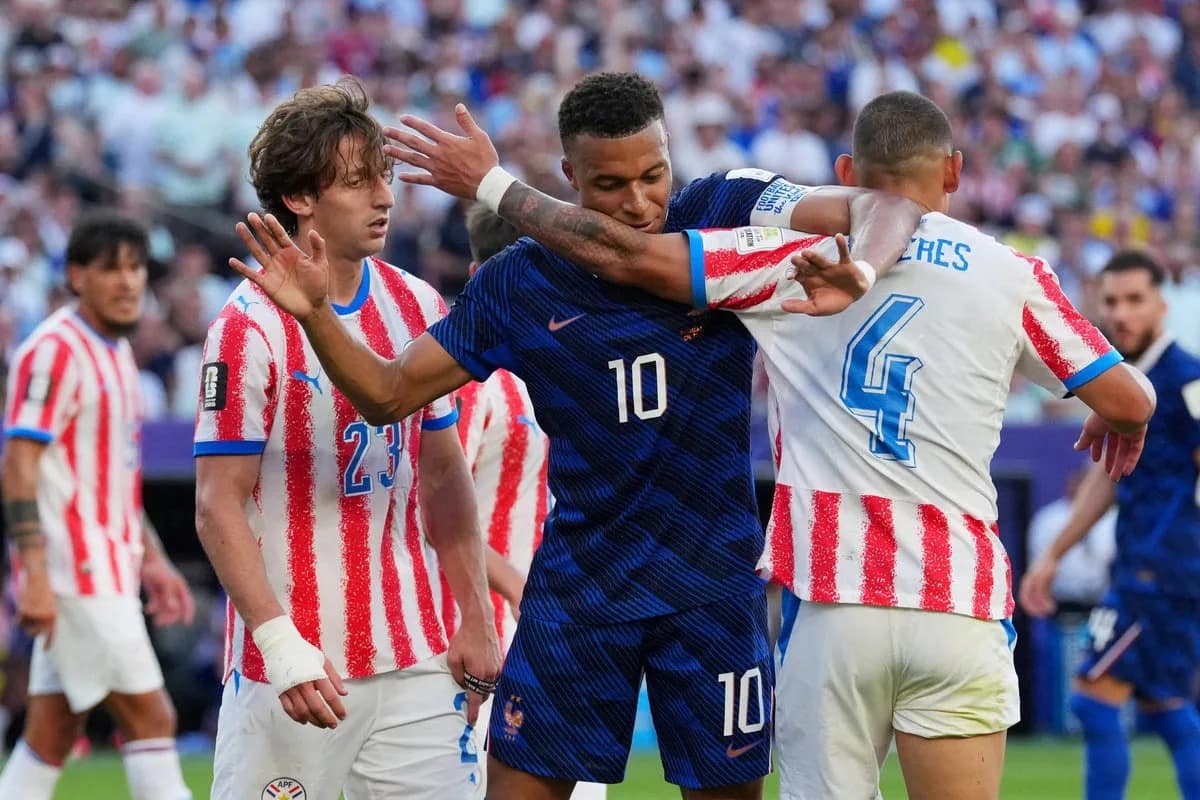
Far below Philadelphia’s City Hall, on the subway platforms as fans streamed back from the Lincoln Financial Field, shirts bore the names of Leroy Sane, Jamal Musiala, and Joshua Kimmich—the players they hoped to see on July 4. They had bought tickets for a different contest, but France and Paraguay had their own version of a match-day spectacle. France did not get the game they might have savored—a World Cup win over Germany would have been thrilling—yet their encounter with Paraguay was no easy ride either. There, the affair resembled a prolonged nuisance more than a celebration, an exhibition of off-the-ball fouls, dives to the turf, and scuffed penalty spots designed to delay and provoke. Depending on interpretation, it was disgraceful, mildly irritating, or a justified ploy to blunt a superior foe.
If Sweden could be accused of being too accommodating when they fell to France, Paraguay could scarcely be charged with that fault. Every other opponent had yielded at least three goals to the tournament favorites; Paraguay conceded only once, from a penalty. Was that due to opportunistic harassment or genuinely superb defending, though the latter would attract less attention? Gustavo Alfaro, the Paraguay coach, said his side “fought like lions.” Yet some tactics hardly fit the king of beasts. Officially, they fought clean. That Paraguay managed only 13 fouls was almost laughable; for the first time in 28 years, they completed a World Cup game without a single booking, suggesting immaculate conduct to some observers. In truth, it underscored the baffling display of Ilgiz Tantashev, the Uzbek referee, who seemed unable to recognize Paraguayan infractions. Still, the encounter felt less like Philadelphia theater and more like an extended exercise in s**thousery, tinged with pettiness and a streetwise edge. Some offences stopped short of violent conduct, while others seemed engineered to spark a France reaction.
“I am really proud the entire team kept its cool. If we had responded to provocation, it could have been bad,” said Didier Deschamps. Yet there was French disdain for Paraguay’s antics, even as their captain emerged as the match-winner and savored the method of victory. “We know how to play ‘dirty’ football. They thought we’d appear in tuxedos, but we were ready for the fight,” described Deschamps, maintaining composure amid the frustrating tactics. After the final whistle, goalkeeper Orlando Gill struck the ball at Mbappe’s back, and Mbappe himself became the story’s focal point, a symbol of resilience amid provocation.
Content Source: Yahoo News
Image Credit: Getty Images
All rights to the news content and images belong to their respective copyright owners.